The price comes from the shop and can change. Check price, size and delivery on the shop's page before you order.
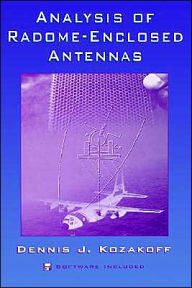
This new book and software package provides you with the analytical tools you need to evaluate and predict the effects of a radome on an enclosed antenna, including transmission loss, boresight error or boresight error slope, depolarization, or a degradation of the antenna sidelobe levels. It features a comprehensive overview of radome wall concepts and materials, and presents ray trace approaches to help you easily achieve solutions using your PC. The book is accompanied by interactive software that lets you compute antenna patterns and boresight error of gimbaled radar antennas in a multilayer radome. It includes two modules: WALL • Solves the multi-layer dielectric layer system as a boundary value problem • Computes total wall transmission versus angle-of-incidence for parallel and perpendicular polarization • Outputs data in tabular form, with computational angles-of-incidence up to 89 degrees from the normal RADOME • Computes the effect of a multi-layer dielectric wall tangent ogive shaped radome on the radiation pattern of an enclosed monopulse antenna • Lets you select the fineness ratio of the general ogive shape (from F=0.5 to F1) • Includes two antenna gimbals: azimuth over elevation (AZ/EL) and elevation over azimuth (EL/AZ) Data from both programs can easily be imported into other software programs such as GRAPHER or LOTUS 123 for high-quality plotting, viewing, and editing. Both programs can handle up to 15 dielectric layers. System Requirements: IBM-compatible 386 or higher (Pentium recommended) with a math coprocessor. 4 MB RAM. Epson-compatible printer to output data.